Big no to ‘knot’ with a vow against child marriage | Lucknow News
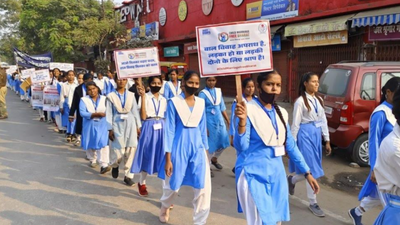
On the dusty outskirts of a village in Jhansi, a group of teenage girls sat quietly in a corner during an awareness session on child marriage. Villagers gathered to hear members of an NGO explain how marrying off children can affect their health, disrupt their education, and even invite legal consequences.For most adults, the talk seemed like yet another routine awareness programme, but among the girls sitting together, something else was unfolding.They exchanged nervous glances and whispered something among themselves. Years of experience in child protection taught the team from Bundelkhand Seva Sansthan to notice such small signs.“One of the girls appeared particularly anxious,” recalled Amardeep Babina, district coordinator of the organisation, which works with Just Rights for Children — a conglomerate of some 250 civil society organisations across India committed to child protection and support.“Even when we asked if anyone wanted to share something, she quickly said ‘no’. But it was clear she was holding something back,” he said.Later, only when the team spoke to her privately, that the truth emerged. She revealed that her friend, just 16, was about to be married off by her parents who feared that the girl might fall in love with someone and eventually elope. She tried to convince her parents but failed. Then she confided in a friend who alarmed the activists. “I will not elope with anyone. But if they marry me now, I will run away from home,” she said.For those working in child protection, such words are a warning sign. “Children who run away from home are a sitting duck for traffickers. So, we knew we had to act immediately,” said Basudev, director of Bundelkhand Seva Sansthan.Soon after, the NGO team, accompanied by local ASHA workers, visited the girl’s home. Instead of confrontation, they chose conversation. For hours, they counselled the parents about the consequences of child marriage and how it could jeopardise a girl’s health, derail her education, and expose families to legal penalties.They also reminded the parents that the girl was a bright student who could one day support the family if allowed to study. Gradually, the resistance softened and, eventually, the girl’s parents gave in writing that they would not marry her off before she turned 18.A heartening headwayFor the Jhansi girl, the moment was transformative. Over a year since, she, along with her friend, began spreading awareness among their peers, telling other girls that if they faced pressure to marry early, they could seek help.They also shaped their own career goals. But the bigger and better news was that the girls lend a face to a heartening revolution — that of taking the first step towards self-empowerment, which serves as the building block for women empowerment.Going by numbers provided by Just Rights for Children, more than 39,500 girls from different parts of UP refused to underage marriage between April 2023 and Feb 2026. The NGO consortium has 25 partner organisations in UP working across 41 districts. Preventing child marriage is one of the many causes they uphold, besides child trafficking, labour, and abuse.“Child marriage has long been woven into our social fabric. Though it is illegal, the practice has not completely disappeared. Yet widespread support from every section of society offers hope. It feels as though India stands at the threshold of making history,” said national convenor of Just Rights for Children Ravi Kant.Data from the fifth National Family Health Survey (NFHS) shows that while there is a drop in overall prevalence of child marriage over the past couple of decades, it remains high.Numbers indicate that 23.3% women in the age group of 20-24 were married off before they turned 18. UP is way below the national average, but the problem remains significant, with one in six young women confirming that they were married off before the legal age.From ‘know’ to ‘no’Having worked in the social sector for over three decades, director of partner NGO Aparajita Samajik Samiti, Kiran Bains, said that transformations begin with a ‘no’. “No matter how much the society or system supports, we cannot go very far till we hear the first sign of dissent. It puts everything in motion and helps in either preventing or stopping child marriage,” she shared.“At the root of this ‘no’ is awareness. Efforts made over the past decades are now yielding dividends. The girls know the ills of underage marriage and that they are at the receiving end of this social problem. Sustained drives also gave them the know-how of what to do if their elders impose their wrong decisions on them,” she noted.Ravi Kant said that the cause gained momentum since the launch of Bal Vivah Mukt Bharat in Nov 2024.“The movement to end child marriage is gaining momentum, thanks to our community workers, district and state officials, and child protection foot-soldiers who are working with renewed zeal,” he noted.Case studies from many districts prove the point. Workers from Jan Vikas Sansthan conducted a meeting in the village to spread awareness about the dangers of child marriage and inform families about govt welfare schemes.A woman approached them for financial assistance for her daughter’s marriage. When a worker asked for the girl’s age, the answer raised alarm bells. She was just 14. The activist spoke to the girl and gently explained that she had the right to continue her education and that marrying before 18 was illegal. Until then, the girl had quietly accepted the decisions being made for her, but the conversation changed something inside her. She decided to stop the marriage. “I chose life and opportunity over fancy gifts,” said the girl who took to stitching and embroidery to become financially independent.Today, she is a vocal advocate in her community, encouraging other girls to stand up for their rights.In yet another case, a girl from Ayodhya had lost her parents in an accident and lived with her maternal aunt. Her younger brother stayed with his grandparents in another district.While she was studying in Class X, her guardians decided to marry her off to a 45-year-old man from Rajasthan. Members of Aparajita Samajik Samiti received a tip-off about the impending marriage and alerted the child welfare committee. A rescue team reached the house just in time.The prospective groom, who arrived to discuss the wedding, fled when officials intervened. Investigations later suggested that the man had links with trafficking networks and that money had exchanged hands for the marriage.When the girl appeared before the child welfare committee, she did something few children her age would dare to do. She spoke against her own guardians.“I don’t know what I want. But I know what I don’t want. I don’t want to go home. They will marry me off,” the girl said. Taking her safety into account, the committee decided to lodge her in a shelter home in Lucknow so she could continue her education.Reiterating commitmentMinister for women and child development, UP, Baby Rani Maurya said that marriage at a young age deprived girls of many opportunities.“It takes a toll on their health and quality of life, and it is heartening to know that the girls are taking a stand against it. Aware of the ills of child marriage, the Union govt launched the Bal Vivah Mukt Bharat Abhiyan. The state govt is also committed to the cause,” she said.“The department of women and child development uses its own network to curtail underage marriages with the help of field officers and social organisations. The NFHS data speaks for 2019-20 and we are hopeful that the scenario will improve in subsequent surveys,” she said.UP records 22.4l pledges in 100 daysUttar Pradesh has emerged as top performer in the 100-day long nationwide intensive awareness and outreach exercise launched under the Bal Vivah Mukt Bharat Campaign, recording more than 22.43 lakh pledges and conducting over 2.29 lakh awareness activities across all 75 districts, according to official data released ahead of the campaign’s conclusion on March 8. “The state is ahead of other big states, with Maharashtra reporting about 10.7 lakh and Chhattisgarh around 2.42 lakh pledges. In public participation, UP’s outreach is nearly 10 times than that of Andhra Pradesh, reflecting extensive community mobilisation and coordinated administrative efforts,” said additional chief secretary, women and child welfare, Leena Johri. “The campaign’s reach has been driven by coordinated efforts of district administrations, police, frontline workers, schools and community organisations. Under the Prohibition of Child Marriage Act, 2006, district probation officers serve as child marriage prohibition officers, strengthening vigilance,” said Johri.