Bharat’s real village life came alive in Shrilal Shukla’s seminal works | Lucknow News
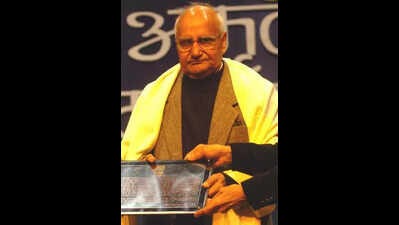
Lucknow: Among the books that continue to draw readers’ interest generation after generation is Shrilal Shukla’s timeless classic “Raag Darbari”, which remains both popular and relevant even after five decades of its publication.The book won Shukla the Sahitya Akademi award in 1969 and became one of Hindi literature’s most read and translated novels.
Shukla, whose 100th birth anniversary is on Wednesday, is celebrated till date for his sharp wit and satire on the Indian power structure portrayed through the village of Shivpalganj in his epic book. He wrote more than 30 books, including novels, satires, short stories’ collections, and memoires.Senior journalist and activist Vandana Mishra said Shukla remains one of the most relevant literary voices in India even today. She described him as exceptionally well read, open-hearted, and deeply observant of the society. Raag Darbari, she said, shattered the romanticised image of village life and replaced it with sharp honesty and satire.Written during a phase of strong anti-establishment politics, the novel questioned power structures, corruption, and social hypocrisy, concerns that continue to resonate decades later. “Raag Darbari is still widely read, particularly by young readers, because the conditions it portrays have not fundamentally changed. Village politics, panchayat functioning, college power struggles, and the everyday hardships faced by the poor in courts remain strikingly familiar,” Mishra noted.Writer Vibhuti Narayan Rai said Shrilal Shukla’s life and language were as distinctive as his literary vision. He recalled that Shukla began his career as a PCS officer in Uttar Pradesh and later became an IAS officer, successfully balancing administration with creative writing. Alongside his bureaucratic career, he emerged as a major writer, with Raag Darbari widely regarded as one of the ten greatest novels of the 20th century. Rai described Shukla as a contrarian with a sharp sense of wit and a worldly outlook. “He was not removed from life. He was successful as a human being and as a bureaucrat, and his humour stayed with him till the end,” he said.Speaking about his writing style, Rai noted that Shukla’s prose reflected contemporary speech. His language was a natural blend of Hindi, Urdu, and Sanskrit, closely aligned with how people actually speak and write. For writers today, Rai said, Shukla remains an example of the importance of mastering the language of one’s own time.Born on Dec 31, 1925 in Mohanlalganj on Lucknow’s outskirts, Shukla graduated from Allahabad University and cleared provincial civil service in 1949. He settled in Lucknow during his professional life and remained nestled there till his last breath in 2011. He had three daughters and a son and lost his wife, Girija, in 1997.His first novel, “Sooni Ghati Ka Sooraj” came out in 1957. Shukla received the Vyas Samman in 1999 for “Bishrampur ka Sant”, the Padma Bhushan in 2008, and the Jnanpith Award in 2011. “Agyaatvaas”, “Aadmi Ka Zahar”, “Seemayein Tootati Hain”, “Makaan”, and “Raag Viraag” were his other popular novels.Poet and critic Ashok Vajpeyi told PTI: “What he did in Raag Darbari – showing how this so-called development was riddled with paradoxes, corruption, delays, negligence, carelessness, and inertia, and how it affected people’s everyday lives – was truly significant.”Senior journalist and writer Akhilesh said Raag Darbari deconstructs the post-independence development model and exposes its inner contradictions. “After Independence, development became a grand slogan, and it continues to be so even today. Raag Darbari fragments that narrative and reveals what lies beneath the glitter,” he said. According to him, the novel also broke the nostalgic portrayal of villages prevalent in Hindi literature, presenting instead a raw, unornamented reality. Though initially criticised by some for lacking epic scale, the novel eventually established itself as the most widely read and deeply assimilated work of post-Independence Hindi literature.Veteran actor Anil Rastogi said Shrilal Shukla’s significance lay in the rare balance he achieved as a bureaucrat who remained a sharp critic of the misuse of govt policies. Part of the system yet never its apologist, Shukla used literature to expose how policies were distorted at the ground level, Rastogi said.Rastogi recalled adapting “Raag Darbari” for theatre and television, and said that even as cultural secretary and director of cultural affairs, Shukla worked tirelessly to promote art and culture, always speaking truth to power from within the system.Ashok Maheshwari, chairperson and managing director, Rajkamal Prakashan, told PTI ,”Raag Darbari” shows the ugliness or deformities afflicting our villages, which exist to this day, the political manipulations, the difficulties people face in village life, all presented realistically. This makes it a relevant novel even today.”