We have freed country from tendency to link all good works with one family: PM | Lucknow News
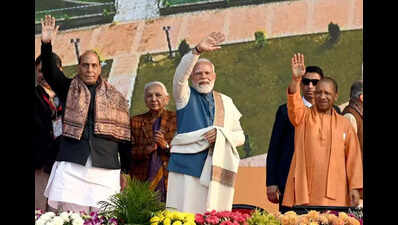
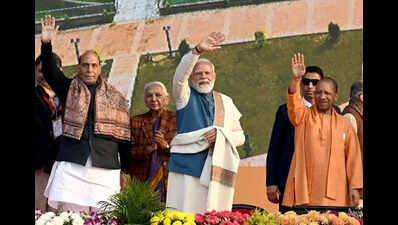
Lucknow: In a scathing attack on Congress, PM Narendra Modi on Thursday said that past governments promoted a “one family” culture while neglecting the contributions of several national icons, adding that that BJP government has freed the country from the “tendency” to associate every good work done after independence to just one (Nehru-Gandhi) family.Speaking here after inaugurating the Rashtra Prerna Sthal, he also said that ‘BJP was proud that our government had the opportunity to tear down the wall of Article 370’, adding that the legacy of good governance created by the BJP-led NDA government was now being taken to new heights at both the Centre and state levels. He also accused the Congress and its allies of attempting to make BJP a “political untouchable” over the years.
“After independence, a tendency to connect all the good work that took place in India to the same family emerged. Whether it be books, government schemes, government institutions, streets, roads, or squares, it was all connected to the pride of one family… BJP has also taken the country out of this old system linking all good works to one family. Our government, serving Mother India, is giving respect to every child, to everyone’s contribution,” Modi said, after inaugurating the Rashtra Prerna Sthal, a memorial housing 65 feet tall statues of Jan Sangh leaders Syama Prasad Mookherjee, Deen Dayal Upadhyay and former PM Atal Behari Vajpayee in Lucknow. Defence minister Rajnath Singh, Governor Anandiben Patel, Chief Minister Yogi Adityanath and several other BJP ministers and functionaries were present on the occasion.Constructed at an estimated cost of around Rs 230 crores, the memorial sprawling over an area of 65 acres, also houses a lotus shaped museum depicting the life and journey of the three stalwarts. Modi’s stance was seen as anchored in BJP’s sharp narrative contrasting dynastic politics with what it projects as merit based recognition. Asserting that his government was giving respect to contribution by everyone, Modi highlighted that the statue of Subhash Chandra Bose has been installed in Delhi’s Kartavya path, while the island in Andaman and Nicobar where Netaji unfurled the tricolor has been named after him. The PM lashed out at the Congress for making attempts to dismantle the legacy of Dalit icon BR Ambedkar. “Dilli ke shai parivar ne ye paap kiya…( The royal family of Delhi committed this sin),” he charged. Modi also accused the Samajwadi Party of towing the lines of Congress.Stressing that the BJP did not let the legacy of Ambedkar diminish, Modi said that the panchteerth associated with Ambedkar were now hoisting his legacy. Likewise, he said, attempts were made to lessen the stature and achievements of Sardar Vallabhbhai Patel who united the country. Modi said that the BJP ensured the honour for Patel by getting his statue — world tallest one – constructed in Gujarat. Modi said that the contribution of scheduled tribes, too, remained neglected for decades. “It was our government which got a massive memorial constructed in the name of tribal Birsa Munda (the tribal freedom fighter and religious leader, in Ranchi),” he said, adding that it was only recently that a memorial in the name of Veer Narayan was dedicated to the people in Chhattisgarh. He said that a memorial in the name of Maharaja Suheldev was constructed in Bahraich after BJP came to power in UP. “The meeting place of Lord Rama and Nishadraj – Shringverpur near Prayagraj — has finally received the respect and recognition it deserves. It was the BJP which remembered Maharaja Mahendra Pratap and martyrs of Chauri Chaura,” he said.Modi said that the politics of `parivarwad’ has “one special identity”. “It is full of insecurity. Shortening lines drawn by others is their necessity. They do so to appear superior to others and their businesses continue to thrive,” he said, adding that it was this thought process which initiated the practice of political untouchability in the country.“But BJP `sanskaar’ taught us to respect everyone,” he said. Modi cited how various former PMs were ignored in a Delhi museum. “This too has been changed. The PM museum in Delhi is now giving respect to every former PM, irrespective of their tenure,” he said. The PM said that it was during the past 11 years of NDA rule that Bharat Ratna was conferred on former PMs — PV Narsimha Rao and Pranab Mukherjee – both from Congress. “Likewise, SP patriarch Mulayam Singh Yadav and former Assam CM Tarun Gogoi (a Congress leader) were given national awards,” he said, adding that conversely BJP leaders faced humiliation from the opposition. Meanwhile, hailing UP and the Yogi Adityanath government, Modi said that the state was once known for poor law and order. “Today, the state is being discussed for development. The state is emerging as a dream tourist destination,” he said, citing the example of Ram Temple in Ayodhya and Kashi Vishwanath Dham, and added that UP has also emerged as the largest manufacturer of mobile phones. ‘We’ve given new deminsion to Antyodaya’PM Narendra Modi on Thursday asserted that his government has given Jan Sangh leader Deen Dayal Upadhyay’s vision of `Antyodaya’ (uplifting the poorest of the poor), a new dimension through what he called “saturation of welfare schemes” while ensuring there remains no discrimination between various communities in the country.“Humne antyoday ko saturation ka naya vistaar diya hai. Saturation yani har zarooratmand har labharathi ko sarkar ki kalyanakari yojana ke dayare mein lane ka prayaas… jab saturation ki bhavana hoti hai to bhedbhaav nahin hota… (We have given a new dimension to Antyodaya (uplifting the poorest of the poor) through saturation. Saturation means making an effort to bring every needy person and every beneficiary under the ambit of the government’s welfare schemes... when there is a spirit of saturation, there is no discrimination),” Modi said, after inaugurating Rashtra Prerna Sthal in Lucknow.“And this is what good governance, social justice and real secularism is all about…,” he said, stressing that it was the first time that people of the country were getting a house, toilet, water, electricity, ration, gas connection and medical treatment “without any discrimination”.”Justice has been done with the vision of Deen Dayal Updhayay,” he said, adding that in the last one decade over 25 crore people have come out of poverty. He also attacked Congress’s slogan of `Gareebi Hatao’ and setting it as a benchmark of governance. “It was Atal Behari Vajpayee who brought good governance to the ground level in real terms. It was Vajpayee government who worked towards digital identity of people, in what has now been popularised in the form of Aadhar card,” he said. Modi also credited Vajpayee for ushering in the telecom revolution which has eased the reach of phones and internet to every household. “Today India is worlds’ biggest user of mobile and internet in the world,” he noted. “Atal ji would be happy to see that India is the world’s second largest manufacturer of mobile phones in the country. And UP, which he represented as a parliamentarian, is the country’s biggest manufacturer of mobile phones,” he said. Earlier in the day Modi posted on X account: “The birth anniversary of the revered Atal Ji is a special occasion for all of us to draw inspiration from his life. His conduct, grace, intellectual fortitude, and unwavering commitment to placing the nation’s interests above all else set an exemplary standard for Indian politics. He demonstrated through his life that greatness is established not by position, but by character, and it is character that guides society.“ “BJP-NDA Sarkar ne sushasan ki jo virasat banayi hai use aaj BJP ki Kendra aur nrajya sarkarein naya aayam naya vistaar de rai hain… (The legacy of good governance that the BJP-NDA government has built is now being given a new dimension and expansion by the BJP’s central and state governments),” he said. Modi hailed Syama Prasad Mukherjee for playing a decisive role in guiding the country. “He rejected the concept of two flags, two constitutions, and two heads of state in the country,” he said, stressing that even after independence, article 370 in J&K remained a major challenge to the integrity of India.